How can we make our services trauma-responsive if we don’t find ways to hear the voices of those who’ve experienced trauma in their lives?
That’s the question driving our ongoing trauma project at Back on Track, funded by the GMCA’s Violence Reduction Unit in partnership with GMCVO. But this also highlights another fundamental question – how can we actually equip people who have experienced trauma with the ability to be involved in that process in a way that is genuinely empowering and productive? Or, to put it another way, how do we turn “co-production” from an often used aspirational term into meaningful activities that harness the authentic and invaluable insights of those with lived experience?
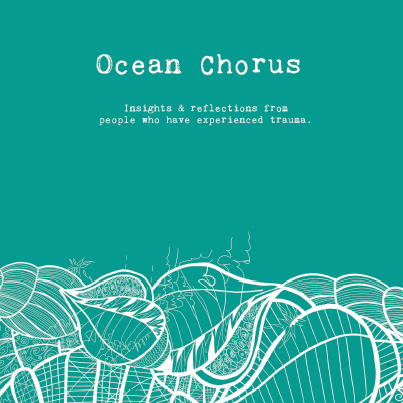
One of the answers comes in the form of Ocean Chorus, a creative and educational “zine” that is one of the main outputs of our trauma project. Intended for support services and others with experience of trauma, Ocean Chorus was co-produced by our members and written entirely in their own words. Those words were collected from discussions and written work during a two-part course called “Understanding Trauma” which ran at our community learning centre in Ancoats from January to April 2023: an initial 6-week psycho-educational course was followed by a series of sessions focusing on the composition and design of an informal magazine publication, or “zine”.
[desktoponly]
[/desktoponly][mobileonly][/mobileonly]
The course was not group therapy, nor any kind of treatment for trauma. Rather, its emphasis was solely on education. It was for those interested in learning about trauma and for those interested in having a say about how services should support people who have faced trauma in their lives. In this context, the course’s aims for its members were to provide:
• A basic understanding of trauma, and the different ways it can affect our lives
• A basic understanding of the terms ‘trauma-informed’ and ‘trauma-responsive’
• A space in which to reflect on their own experiences of using any type of support services
This course consciously set out to create a safe and supportive environment for our members. Central here was a co-created group agreement that ensured a positive learning experience for every member, together with the trust and peer support that came from the course being a closed group with a shared commitment to attend each week.
In this supportive and carefully facilitated setting, our members were able to use their own experiences of the barriers they have previously faced accessing services to reflect on what trauma means to those who have faced it and to use this insight to develop recommendations for services to shape their responses accordingly.
This approach also has important benefits for the members involved, enabling them to feel better understood and ultimately empowered to make positive changes in their own lives. As one member put it: “The project was so important because very often my actions are misunderstood, even by those closest to me. Unless you’ve experienced something like this and people are really aware, they can’t know what to look out for.”
The project is continuing with work on a ‘Trauma Reflections’ self-assessment tool, which has also being co-designed with input from our members. This tool will accompany the “Trauma Reflective” workshops that we have been delivering as part of our Changing Futures partnership and that we continue to offer more widely. In doing so, we hope to encourage organisations to be more accountable in making changes to promote trauma responsive practices.
Combining all of these approaches demonstrates the genuine value of lived experience insight in shaping resources created by organisations. At Back on Track, our members have opportunities to have their voices heard to bring change to services that support them.
Jackie Richardson
Services Manager (Multiple Disadvantage)